
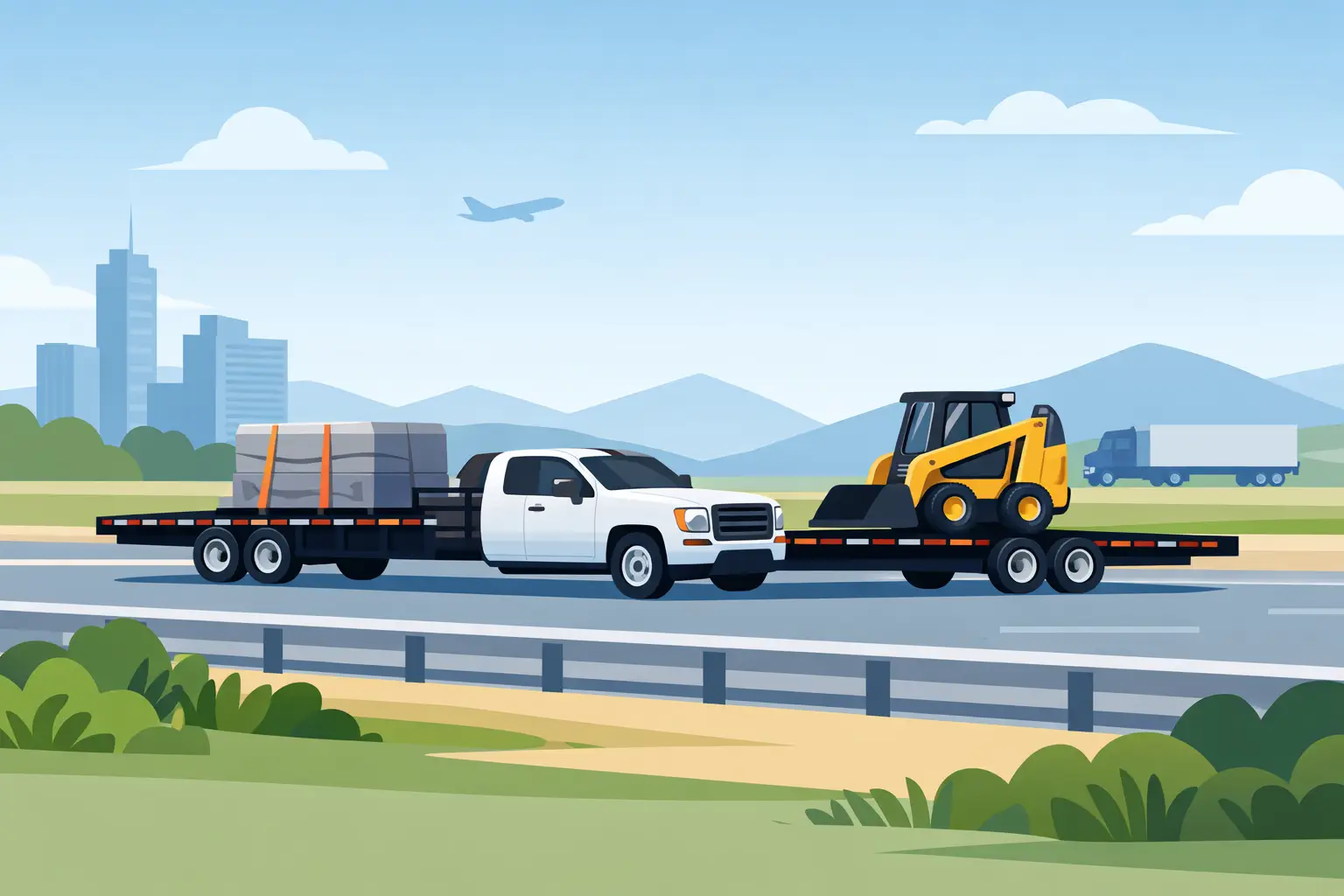
A shutdown line does not care what the brochure says your truck can do. What matters is what the truck, trailer, driver, and load can legally and safely move right now. If you are asking how much can a hotshot haul, the honest answer is not one flat number. It depends on the equipment rating, trailer type, axle setup, cargo dimensions, and the legal weight limits on the route.
For shippers moving urgent freight, that distinction matters. A hot shot setup may be the fastest answer for a time-critical load, but only if the freight fits the real operating capacity of the unit being dispatched.
How much can a hotshot haul in real-world terms?
Most hot shot loads are moved with a medium-duty or heavy-duty pickup and a gooseneck trailer. In many cases, the working payload lands somewhere around 8,000 to 16,000 pounds. Some lighter setups will be below that. Some heavier, properly spec’d combinations can push higher within legal limits.
That range is broad for a reason. The trailer’s gross vehicle weight rating, or GVWR, is only part of the equation. You also have to account for the truck’s own weight, fuel, tools, straps, chains, dunnage, and anything else riding with the load. A trailer rated for 20,000 pounds does not mean you automatically have 20,000 pounds of usable freight capacity.
For a shipper, the practical question is less about maximum advertised capacity and more about legal payload. That is the number that determines whether the load can move without creating compliance issues, roadside delays, or equipment stress.
The equipment decides the answer
Hot shot hauling is not one uniform equipment class. Different truck and trailer combinations can produce very different results, even when both are called hot shot service.
A common setup uses a one-ton dually pickup with a 30- to 40-foot gooseneck trailer. Depending on axle ratings and trailer construction, that may be suitable for machinery, crated parts, steel, pipe, generators, jobsite materials, or palletized industrial freight. But the legal capacity changes with the actual curb weight of the equipment.
A lighter trailer may give you more payload but less deck strength or fewer tie-down options. A heavier trailer may improve durability and cargo control but eat into usable capacity. Air ride can protect sensitive freight, but it may also affect total available payload depending on the build. There is always a trade-off.
Truck ratings matter more than many shippers realize
The truck itself sets hard limits. Gross combined weight rating, rear axle rating, tire capacity, brake capability, and hitch rating all come into play. If any one of those numbers is exceeded, the load is not properly matched to the unit.
This is why experienced hot shot carriers ask specific questions before confirming capacity. They need the shipment weight, dimensions, loading method, center of gravity, and whether the freight is top-heavy, uneven, crated, or requires tarping. Two loads with the same weight can behave very differently on the road.
Trailer type changes what can be hauled
Flatbed goosenecks are common because they handle a wide range of freight quickly. Low-profile trailers may help with taller cargo. Dual tandem axle configurations can improve distribution. Dovetail trailers can make loading easier for wheeled equipment, but they may reduce usable flat deck space.
That means capacity is not only about pounds. Deck length, deck width, loading angle, and cargo securement points also determine whether the shipment is a fit for hot shot service.
Legal limits versus theoretical capacity
A carrier may have equipment strong enough to pull more weight than it can legally haul. That difference matters.
Federal and state regulations govern how much weight can be carried on public roads. In many non-CDL hot shot setups, operators aim to stay under 26,000 pounds gross combined vehicle weight rating. Once the truck and trailer ratings exceed that threshold, CDL requirements may apply, along with other compliance obligations.
For shippers, this affects availability and planning. A load that looks close on paper can cross into a different service category once actual scale weight is considered. If the cargo is dense and heavy, a standard hot shot unit may not be the right answer even if the freight only takes up part of the deck.
Bridge formulas, axle spacing, and state-specific rules can also affect legal transport weight. So can oversize or overweight permit requirements. If the load is urgent, the last thing you want is to lose time because the shipment was booked on equipment that was never a legal match.
What usually fits hot shot hauling well
Hot shot service is often the right fit for freight that is urgent, relatively compact, and too time-sensitive for standard LTL or scheduled truckload options. In industrial and commercial shipping, that often includes emergency replacement parts, steel components, pumps, valves, skid-mounted units, pipe, tools, and production-critical materials.
The freight does not need to be tiny. Hot shot loads can be substantial. But they do need to fit the deck, the axle distribution, and the legal weight profile of the unit. A dense 14,000-pound load may be fine on one setup and a bad fit on another. A long but lighter load may need a different trailer because of deck length and overhang restrictions.
This is where experienced dispatch and operations planning make a difference. Good hot shot service is not just speed. It is speed with the right equipment under the right legal and safety conditions.
Why dimensions matter as much as weight
Shippers often lead with shipment weight, which makes sense. But dimensions can be just as important.
A load that weighs 7,500 pounds may still be a problem if it is too tall, too wide, too long, or difficult to secure. Uneven freight can create balance problems. Tall freight can create route issues under bridges or utility lines. Wide freight can trigger permit requirements and escort considerations, which changes transit time and cost.
Center of gravity also matters. A compact machine with most of its weight forward needs different placement than a long crate with evenly distributed mass. Load position affects tongue weight, axle loading, braking, and handling. That is why a serious hot shot carrier asks for dimensions and photos, not just a total weight figure.
How much can a hotshot haul without risking delays?
The better question for a shipper is often this: how much can a hotshot haul without creating avoidable problems?
That answer usually sits below the highest number someone quotes over the phone. Running at the edge of capacity can limit route flexibility, reduce margin for error, and increase the chance of rework at pickup. If the freight is time-critical, conservative planning is usually the smarter move.
A properly matched hot shot unit should have enough capacity for the load, enough deck space for secure placement, and enough compliance margin to move cleanly through inspections and scale checks. Urgent freight does not benefit from aggressive assumptions.
When hot shot is the wrong fit
Not every urgent load belongs on a hot shot truck. If the shipment is too heavy, too large, too sensitive to road conditions, or requires special permits that erase the speed advantage, another equipment class may make more sense.
That does not mean the shipment cannot move fast. It means the solution may be a larger flatbed, step deck, specialized trailer, or a brokered option with a different carrier profile. The goal is not forcing every load into a hot shot model. The goal is getting the load delivered on time with the fewest operational risks.
For companies shipping in refinery, plant, medical, aerospace, or secure industrial environments, credentials can also influence fit. Access requirements, chain-of-custody expectations, and site rules matter just as much as raw payload numbers.
What to provide when requesting hot shot capacity
If you need a fast answer on whether your freight can move as hot shot, send complete details from the start. Weight and dimensions are the baseline. It also helps to include pickup and delivery deadlines, loading equipment at both ends, packaging type, whether the load can be tarped, and any site access restrictions.
Photos are often the fastest way to avoid mistakes. They help identify lift points, securement needs, overhang issues, and whether the freight will actually sit safely on the available deck.
For urgent commercial freight, that level of detail saves time. It also reduces the chance that a truck arrives only to find out the shipment needs different equipment.
Advanced Express Delivery handles time-sensitive transportation with that operational mindset. The right answer is based on load reality, not guesswork.
If you are trying to figure out how much a hotshot can haul, think beyond a single weight number. The best move is to match the shipment to the legal, physical, and scheduling limits of the equipment before the truck rolls. That is how urgent freight stays urgent instead of becoming a recovery job.